Easy Arabic Words for Kids to Use Every Day
Explore easy Arabic words for kids with Arabic spelling, pronunciation guides, English meanings, and simple activities for everyday practice at home.
Start With Words Your Child Can Actually Use
A cup of water, a favorite book, and a greeting at the door can all become opportunities to practise Arabic. Start with easy Arabic words for kids that connect to things they see and do every day.
This guide introduces a small set of Modern Standard Arabic words and expressions. Your family may use different words in a spoken dialect; explain that difference rather than treating every variation as a mistake.
The English pronunciation guides are approximate. Long vowels are written aa, ee, and oo, while kh represents the sound in خ. Some Arabic sounds have no exact English equivalent, so use a teacher’s spoken model alongside the text. The single-word guides use a simple pause form, without grammatical case endings.
1. Greetings and Polite Expressions
مَرْحَبًا — marhaban — hello. Use it when greeting your child or welcoming someone home.
شُكْرًا — shukran — thank you. Practise after someone passes a book, offers a snack, or helps with a task.
نَعَمْ — naʿam — yes. The symbol ʿ represents ع, a sound best learned by listening to a clear Arabic model.
لَا — laa — no. Teach it alongside yes through simple choices and friendly games.
Try a small greeting exchange at the start of practice. Say marhaban, pause for a reply, then continue naturally instead of making your child repeat the greeting many times.
2. Food and Drink Words for Mealtimes
مَاء — maaʾ — water. The final mark represents a short stop in the voice, corresponding to ء.
حَلِيب — haleeb — milk. The first sound is ح, which differs from the ordinary English h; ask a teacher to model it.
خُبْز — khubz — bread. Listen to the خ sound before asking your child to repeat the word.
تُفَّاحَة — tuffaaha — an apple. Hold the doubled f briefly when saying the word.
Choose one or two items that are already on the table. Say the word while pointing to the item, then ask your child to point to it when they hear the word again. Do not introduce the whole list at every meal.
3. Everyday Objects Around the Home
كِتَاب — kitaab — a book. Use a familiar storybook so the meaning is easy to connect with the word.
قَلَم — qalam — a pen or pencil. ق is different from the English k; practise it with a teacher rather than relying only on the spelling q.
بَاب — baab — a door. Say the word as you point to the door or show a picture of one.
كُرْسِيّ — kursee — a chair. Connect the word to the chair your child uses for reading or drawing.
Put two objects or picture cards in front of your child. Say one Arabic word and invite them to find the matching item. Swap roles so they can choose a word for you to identify.
4. Family Words to Make Learning Personal
أُمِّي — ummee — my mother. The ending ـي means my in these family words.
أَبِي — abee — my father.
أُخْتِي — ukhtee — my sister.
أَخِي — akhee — my brother.
Use the words that fit your child’s family. Look at a familiar photograph together and model a word, or let them create a small drawing of people they want to talk about. There is no need to make every family word part of the first lesson.
5. Add One Short Phrase
هَذَا كِتَاب — haadhaa kitaab — this is a book. The dh in haadhaa represents ذ, similar to th in the English word this.
هَذِهِ تُفَّاحَة — haadhihi tuffaaha — this is an apple.
In these examples, haadhaa is used with the masculine noun kitaab, while haadhihi is used with the feminine noun tuffaaha. Arabic nouns have grammatical gender, including words for objects.
Start by modelling one complete phrase with the matching object. You do not need to explain every grammar rule immediately. Ask a teacher to help choose additional phrases and demonstrate connected pronunciation as your child progresses.
How Many New Arabic Words Should We Start With?
Try two or three useful words as a starting suggestion, then adjust to your child’s interest and confidence. Keep familiar words in the routine before adding more.
Look for understanding as well as repetition. Can your child match the spoken word to the right object? Can they recognize it in a different picture? Can they use it when the object appears naturally?
Avoid a fixed deadline for remembering the list. A child may understand a word before feeling ready to say it independently.
Three Simple Arabic Vocabulary Activities
Object hunt: Choose two familiar words and invite your child to find the matching objects in the room. Take turns giving the clues.
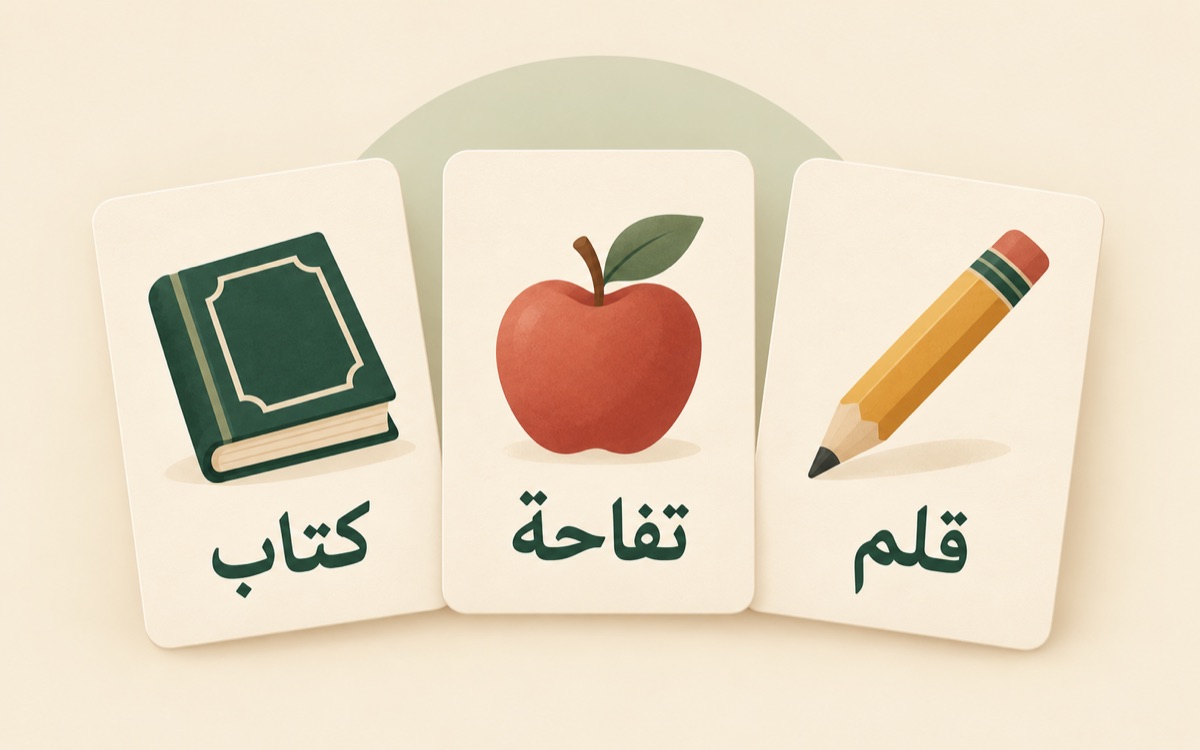
Picture match: Draw a book, apple, and pencil on separate cards. Say the Arabic word and let your child choose the picture. If they are learning to read, add separate Arabic word cards for matching.
Daily helper: Pick one familiar word for a routine, such as water at mealtime or book at story time. Model it naturally and invite your child to join in without making every request a test.
Keep the activities short enough to remain enjoyable. Finish with something your child knows and return to difficult sounds with support rather than repeatedly interrupting the game.
Can I Help If I Do Not Speak Arabic?
Yes. You can organize practice, learn a small set of words alongside your child, and ask the teacher for a clear spoken example of each word.
Do not guess at a pronunciation correction when you are unsure. Make a note for the teacher and focus on matching words to their meanings in the meantime.
If another family member speaks an Arabic dialect, ask them to explain which words they use at home. Help your child recognize when they are hearing a dialect word and when they are practising Modern Standard Arabic.
Should My Child Learn Arabic Reading at the Same Time?
Listening, speaking, and reading can support one another, but they are different skills. A child who recognizes a picture after hearing kitaab may not yet be able to read كِتَاب independently.
Show the Arabic spelling alongside a picture and a spoken model, while keeping reading instruction appropriate to your child’s current level. Ask their teacher how letters, sounds, and word reading will be introduced.
Use English pronunciation guides as temporary support. Gradually connect the sounds to Arabic letters so your child does not have to depend on English spellings.
Build a Small Routine That Fits Your Family
Choose a few words from one part of your day and use them consistently. You might begin with a greeting and two mealtime words, then add a familiar object when your child is ready.
Notice specific progress: recognizing a word without a picture prompt, remembering it the next day, or trying a new sound. Keep practice connected to communication rather than a competition over vocabulary totals.
At Young Muslim, you can enquire about Arabic lessons and discuss your child’s starting level, language background, and goals for speaking and reading.
Keep Exploring Arabic Learning
If you are choosing an Arabic learning goal for your child, explore how Quranic Arabic and Modern Standard Arabic relate to different learning needs.
Quranic Arabic vs Modern Standard Arabic: What Should Your Child Learn?