Quranic Arabic vs Modern Standard Arabic: What Should Your Child Learn?
Compare Quranic Arabic and Modern Standard Arabic, understand how they overlap, and choose a learning path that fits your child’s goals.
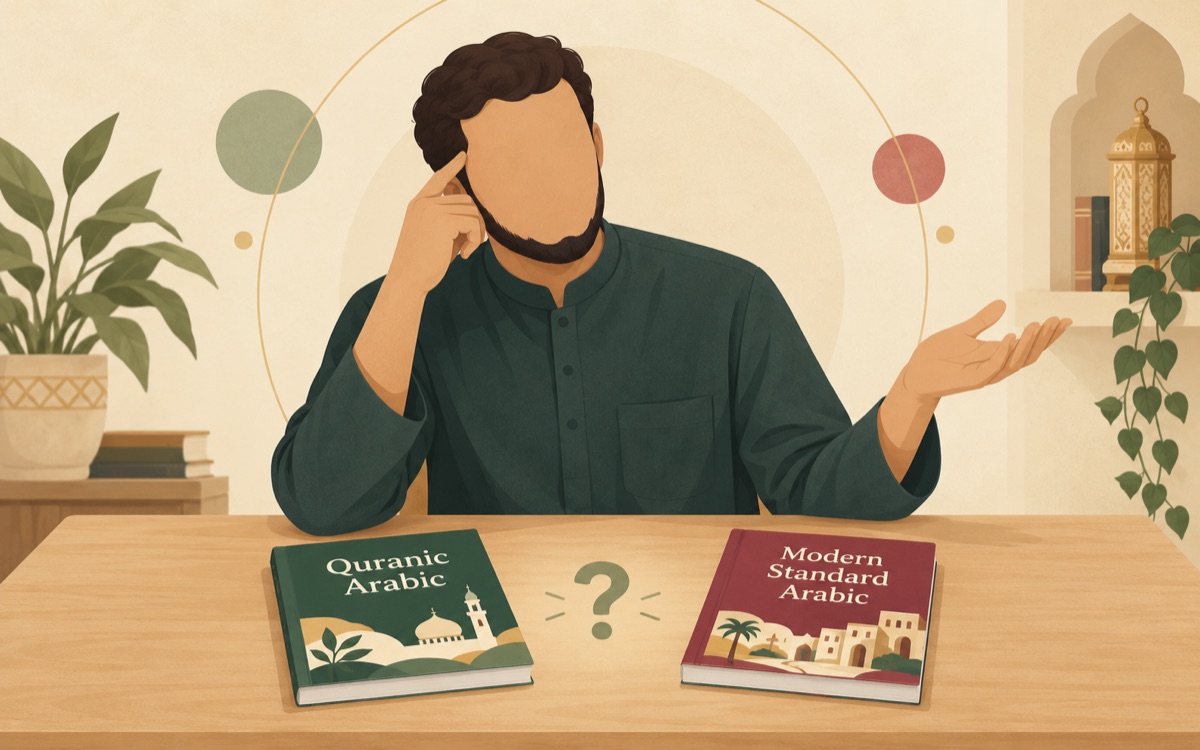
Start With Your Child’s Learning Goal
You want your child to learn Arabic, but course descriptions can make the choice confusing. Should you choose Quranic Arabic, Modern Standard Arabic, or lessons focused on reading Quran?
The answer depends on what you want your child to be able to do: recite accurately, understand familiar Quranic passages, read Arabic stories, write, or communicate with relatives.
These goals overlap, but they are not identical. Understanding the course content matters more than choosing a label that sounds right.
This guide explains the main differences and the questions to ask before choosing lessons.
What Is Quranic Arabic?
Quranic Arabic refers to the Arabic used in the Quran. It is closely associated with Classical Arabic, the broader language of classical literature and scholarship.
A course described as Quranic Arabic may focus on vocabulary, grammar, word patterns, and sentence structures encountered in Quranic passages.
However, course labels are not always used consistently. Some providers use the term for beginner reading or recitation lessons, while others teach language comprehension.
Ask what your child will actually practise and what they should be able to do as a result.
What Is Modern Standard Arabic?
Modern Standard Arabic, often shortened to MSA, is the formal variety widely used in education, news, official communication, and modern written material.
Children learning MSA may work on listening, speaking, reading, and writing through stories, familiar topics, and structured language activities.
A beginner course might introduce greetings, family vocabulary, simple descriptions, and short sentences alongside the Arabic script.
MSA is related to Classical Arabic and shares much of its grammatical foundation. It is not a completely separate language with an unrelated writing system.
How Do Quranic Arabic and MSA Overlap?
Both use the Arabic script and share a substantial foundation in vocabulary, word formation, and grammar.
Learning to recognize letters, read vowel marks, and notice common word patterns can support more than one learning goal.
For example, understanding how a word is built may help a learner approach both a modern reading passage and a Quranic example.
The emphasis differs. A Quran-focused course selects material around the Quran, while an MSA course usually develops broader language skills using modern contexts.
Where Do the Differences Matter?
Vocabulary, expressions, style, and the types of text studied can differ between a Quran-focused course and an MSA programme.
Knowing a modern word for an everyday object does not automatically help a child understand a particular Quranic passage. Equally, recognizing familiar Quranic words does not automatically prepare them for a conversation about school.
Quranic interpretation also requires appropriate explanations and context. Recognizing individual word meanings is a useful step, but it is not the same as fully understanding a passage.
Ask teachers to make these distinctions clear rather than promising that one short course will cover every aspect of Arabic.
Reading Quran Is Different From Understanding Arabic
A child may learn to read vowelled Quranic text aloud without understanding every word they recite.
Recitation lessons can develop reading accuracy, pronunciation, and tajweed. Language lessons may place more emphasis on vocabulary, grammar, and comprehension.
Both can be valuable, but one should not be presented as proof that the other has been mastered.
If your main goal is accurate recitation, ask about Quran reading and tajweed instruction. If your goal includes understanding meaning, ask what language and comprehension teaching is included.
Choose a Quran-Focused Path When Meaning Is the Priority
If your family’s main goal is helping your child understand what they encounter in Quran learning, ask about a suitable Quranic vocabulary and comprehension programme.
A manageable starting point could involve a small selection of familiar words, guided explanations, and simple language patterns.
The teacher should distinguish between a word’s possible meanings and how it is understood in a particular passage.
Your child does not need to begin with advanced grammar terminology. Ask how explanations will be adapted to their age, reading level, and previous knowledge.
Choose MSA for Broader Literacy and Language Skills
If your goals include reading children’s books, writing sentences, understanding formal Arabic, or building a wider language foundation, an MSA course may be a suitable option.
Look for a balance of skills. Ask whether lessons include listening and meaningful communication as well as worksheets or memorized vocabulary.
For a younger learner, familiar themes such as family, colours, food, and daily routines can provide opportunities to use new words.
These are suggested teaching topics, not a fixed curriculum that every child must follow.
What About Speaking With Family?
If your main goal is conversation with relatives, ask which variety of Arabic they normally use.
Everyday conversation often involves a regional dialect, such as Egyptian or Levantine Arabic, rather than only MSA.
A child may benefit from MSA literacy while also learning the spoken variety used at home.
Explain your family’s communication goals to the teacher. A course focused on formal reading may not provide all the conversational practice you are looking for.
Can Your Child Learn Both?
Yes, a learning plan can include Quran-focused study and broader Arabic learning.
Choose manageable priorities and coordinate the work where possible. For example, reading foundations may support both lessons, while vocabulary practice serves different purposes.
Avoid adding several courses simply because their labels sound complementary. Ask what overlaps, what is new, and how much home practice is expected.
Review the workload with your child and teachers so that the plan remains realistic.
Questions to Ask Before Choosing a Course
Does this course teach recitation, language comprehension, or both?
Which variety of Arabic will my child hear and practise?
How do you assess reading, listening, speaking, and understanding separately?
Which books or resources do you use, and how are they adapted for children?
What should my child be able to do after the first stage, and how will you show progress?
How can I support practice if I do not speak Arabic myself?
Does My Child Need MSA Before Quranic Arabic?
Not every learner needs to complete a separate MSA course before beginning Quran-focused study.
The appropriate starting point depends on the programme and your child’s existing skills. Some courses introduce the necessary reading and language foundations as part of the learning plan.
Ask about entry requirements and request an assessment rather than assuming that every beginner needs the same sequence.
Will Learning MSA Make Quran Automatically Easy to Understand?
MSA study can provide useful language foundations, but it does not automatically explain every Quranic expression or passage.
Quran-focused vocabulary, contextual explanation, and appropriate guidance remain important.
Likewise, a Quranic vocabulary course alone should not be expected to produce broad conversational fluency.
Choose a Clear Goal and Build From There
You do not need to choose one path forever. Begin with your child’s current needs and decide which skills matter most at this stage.
Separate recitation, comprehension, literacy, and conversation when discussing goals, then ask how the learning plan connects them.
At Young Muslim, you can enquire about Arabic and Quran lessons and discuss a suitable starting point for your child.