Arabic Numbers for Kids: Learn to Count from 1 to 10
Introduce Arabic counting from one to ten with clear number names, Arabic-Indic symbols, pronunciation support, and simple activities that connect counting with quantities.
Start With the Spoken Count, Then Match It to Objects and Symbols
Teach Arabic numbers by saying a small part of the counting sequence, touching one object for each number, and then matching the quantity to its written symbol. Begin with one to three if ten is too much at once.
This guide uses Modern Standard Arabic for counting on its own. It does not teach the grammar of number-and-noun phrases, which has additional rules. A child can practise the count before learning how to say complete phrases such as ‘three books.’
A Number Name Is Different From Its Written Symbol
The quantity one can be written 1 or ١. Its Arabic name is وَاحِد, while its English name is one. Changing the symbol does not change the quantity.
The symbols ٠١٢٣٤٥٦٧٨٩ are called Arabic-Indic digits in Unicode terminology. The familiar 0123456789 are also used in Arabic-speaking contexts, so do not tell your child that every Arabic book must use the same digit shapes.
For these activities, use the Arabic-Indic forms consistently at first, then show their Western counterparts. Ten is written ١٠: the ١ is on the left of the ٠. Do not reverse the digits because Arabic words run from right to left.
The Arabic Counting Words From 1 to 10
Read each entry as Western symbol — Arabic-Indic symbol — Arabic counting word — approximate pronunciation. The pronunciation guides use pause forms, without adding grammatical case endings.
1 — ١ — وَاحِد — waaḥid
2 — ٢ — اِثْنَان — ithnaan
3 — ٣ — ثَلَاثَة — thalaathah
4 — ٤ — أَرْبَعَة — arbaʿah
5 — ٥ — خَمْسَة — khamsah
6 — ٦ — سِتَّة — sittah
7 — ٧ — سَبْعَة — sabʿah
8 — ٨ — ثَمَانِيَة — thamaaniyah
9 — ٩ — تِسْعَة — tisʿah
10 — ١٠ — عَشَرَة — ʿasharah
The letters aa indicate a long vowel. The th in ithnaan, thalaathah, and thamaaniyah is like the sound in thin. The symbol ḥ represents ح, and ʿ represents ع; these need a clear spoken model rather than an English substitute. The doubled t in sittah should be heard, not skipped.
These are standalone counting forms. You may hear different forms in a dialect or inside a sentence. That does not make every variation an error; tell your child which form you are practising.
Elon.io: Modern Standard Arabic standalone counting forms, one to ten
Activity 1: Move One Object for Each Number
Put three large blocks in a group. Move one into a second group as you say waaḥid, the next as you say ithnaan, and the last as you say thalaathah. Let your child copy, using objects appropriate for their age.
If they say the sequence faster than they move the blocks, slow down and touch one at a time together. If they count the same block twice, keep the counted group visibly separate.
After counting, ask in English how many there are. They can point, show fingers, or give the final number word. This checks the quantity rather than only the memorized sequence. Add more objects when that smaller set is comfortable.
Activity 2: Match a Symbol to a Small Group
Write ١, ٢, and ٣ on separate paper cards. Put one block beside the first, two beside the second, and three beside the third. Count each group aloud, then mix the cards and match them again.
Move the cards around so your child cannot answer from their usual positions. Later, introduce 1, 2, and 3 as another way of writing the same values.
If the symbols are unfamiliar but the spoken count is secure, stay with just two cards. Knowing a number word, recognizing its symbol, and counting that many objects are separate skills.
Activity 3: Build Toward Ten in Two Smaller Sets
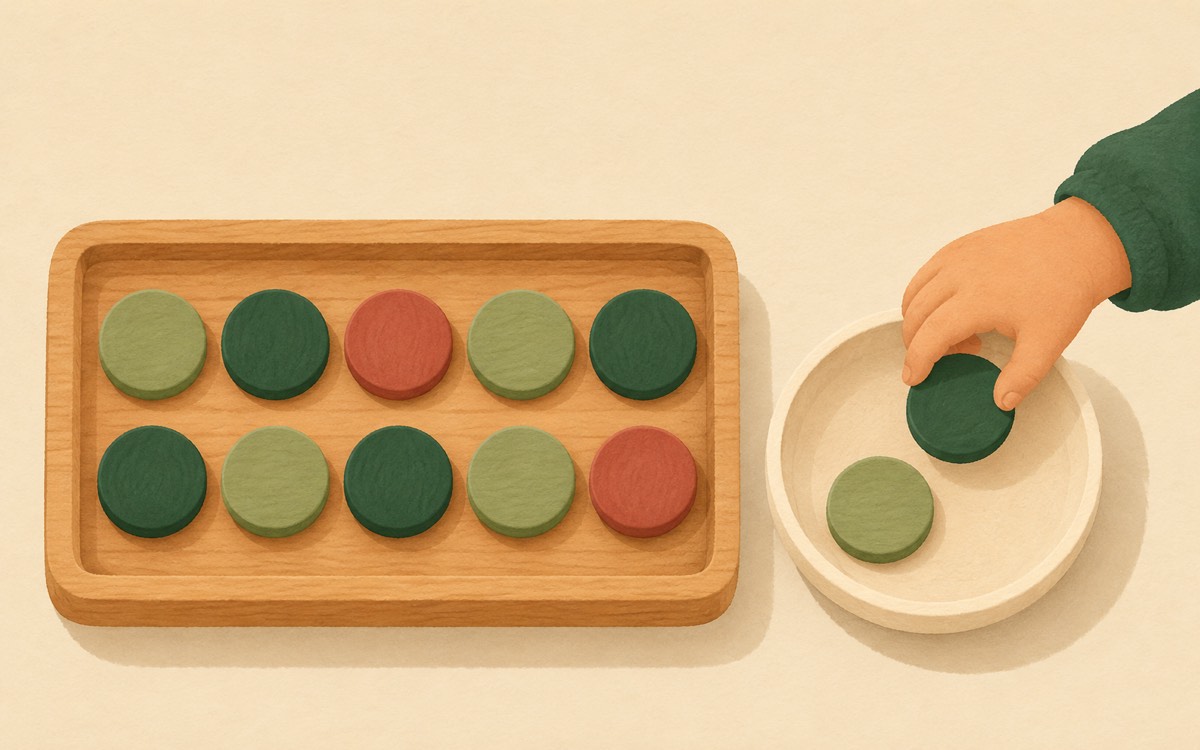
When one to five is familiar, introduce six to ten with the same spoken model. Use two rows of five large counters so your child can move or touch them without losing track.
Count the whole set, then remove some and count what remains. Keep questions simple: ‘How many are here now?’ There is no need to introduce subtraction vocabulary or a new sentence pattern at the same time.
You can also count slow claps or steps. Return to visible objects if coordinating movement and speech makes the activity harder. Use large objects and supervise young children rather than offering small loose counters they could swallow.
Keep Counting Practice Separate From Number-and-Noun Grammar
Reciting the standalone sequence is not a complete rule for building Arabic quantity phrases. Numbers used with nouns involve gender and grammatical forms, and one and two behave differently from three to ten.
For now, let your child count objects while saying the number words on their own. Ask a teacher to introduce complete number-and-noun phrases separately with checked examples rather than attaching each word in the list to any noun.
Keep English pronunciation guides temporary. If a sound is uncertain, request a slow spoken example that matches the Arabic word rather than inventing a spelling to make it look more English.
Al Jazeera Learning Arabic: number-and-noun agreement rules (Arabic parent reference)
Check the Skill, Then Choose the Next Step
Can your child say part of the sequence, count a small group without skipping an object, and match a familiar quantity to its symbol? Note which task needs help instead of treating a song recited from memory as proof of all three.
For a next activity, use our Arabic games guide or add a few everyday words without turning counting into a vocabulary test. If you want guidance on pronunciation and a wider learning sequence, explore our Arabic classes and discuss your child’s current starting point.
Fun Arabic Games for Kids to Play at Home