How to Help Your Child Memorize Short Surahs
Use listening, manageable passages, connected repetition, and regular review to support your child’s surah memorization without rushing pronunciation or progress.
Listen, Repeat a Manageable Part, Then Review It Again
Help your child memorize a short surah by listening to a clear recitation, repeating a manageable passage accurately, joining it to what they already know, and revisiting it in later sessions. A teacher should check the recitation; a parent can organize practice without guessing at corrections.
Choose the amount from your child’s response, not a deadline. One child may need to stay with a single ayah while another can comfortably practise more. The steps below are practical home suggestions, not a prescribed religious formula or a promise of memorization within a set time.
1. Agree on One Starting Passage and One Spoken Model
Ask the teacher which surah and starting passage suit your child’s current pronunciation and reading. A short surah is not automatically easy: unfamiliar sounds can make a few words demanding.
Use a recording the teacher has approved, preferably with clear ayah boundaries and a pace your child can follow. Keep the same model while learning that passage. Check exactly where the practice begins and ends, including how the teacher wants the opening to be recited.
If your child reads Arabic, follow the text together. If they learn mainly by listening, keep reading instruction as a separate goal rather than treating memorized recitation as proof that they can decode the words.
2. Listen Before Asking for Recall
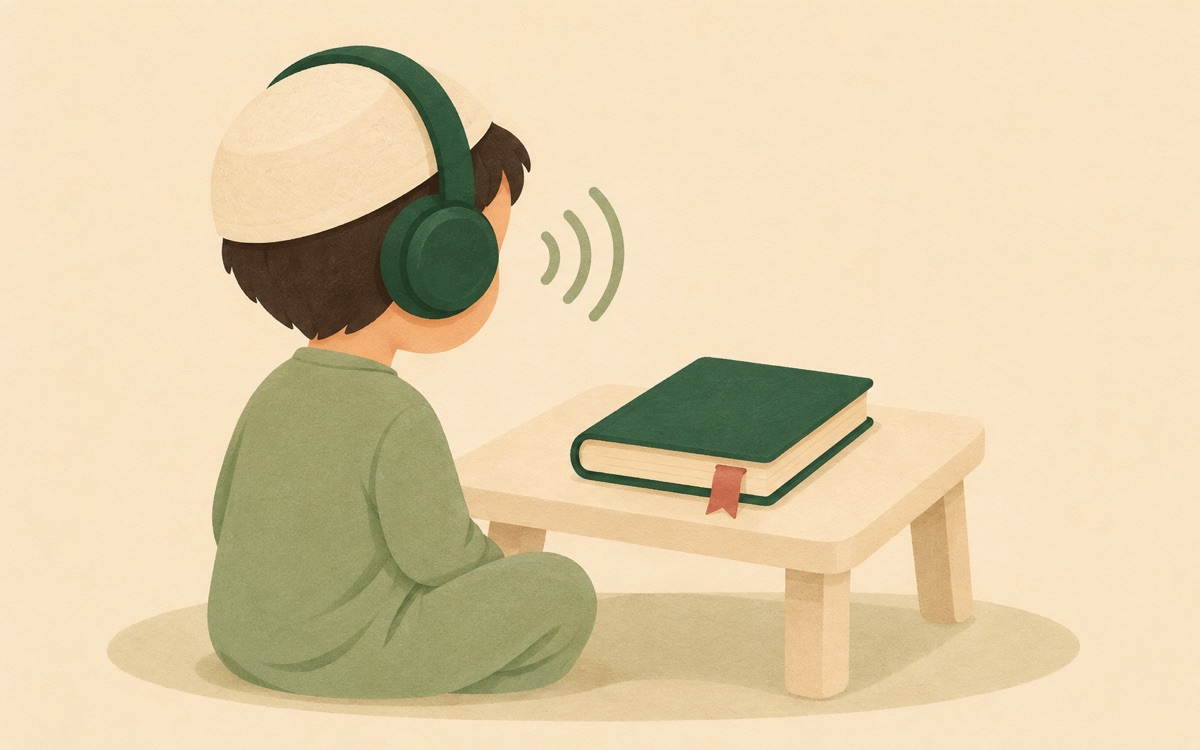
Play the selected ayah while your child listens without speaking over it. Then let them listen again and repeat after the model. Pause the recording so they have time to finish their own attempt.
If an ayah is too much to hold in mind, ask the teacher to mark a suitable shorter phrase and demonstrate its stopping and joining points. Avoid cutting the audio wherever the playback controls happen to stop; Quranic pauses and connections need care.
Change the task if your child is tired. Listening attentively to a small passage can be more useful than repeating a longer one while distracted.
3. Repeat Accurately, Then Try With Less Help
Use a simple pattern: listen to the model, repeat after it, then try once without the recording. If your child cannot continue, supply the agreed prompt or replay the passage rather than turning the pause into a test of willpower.
There is no universal repetition count. Continue while the practice remains attentive, and stop adding repetitions when your child is simply repeating the same uncertain sound.
If you hear something you cannot confidently assess, note the ayah and ask the teacher to check it. A recording provides a model, but it cannot listen to your child and identify an error. Our beginner Tajweed guide explains that correction role in more detail.
4. Practise the Connection Between Ayahs
After your child has practised the next ayah, return to the previous one and recite the pair together using the teacher’s guidance. Knowing each ayah separately and moving between them are different tasks.
For a surah with three ayahs, you might practise the first, add the second, connect the first two, then introduce the third when the earlier work feels manageable. This is an example sequence, not a one-session target.
If your child always hesitates at the same transition, return to that connection rather than restarting the entire surah repeatedly. Ask the teacher to check whether the difficulty is recall, pronunciation, or an uncertain stopping point.
5. Review Older Passages Before Adding More
Begin a session with something previously learned, revisit the current passage, and add new material only if there is room. Keep a small note with three headings: comfortable, needs a prompt, and teacher to check. Move passages between them as your child’s recall changes.
For example, if yesterday’s ayah needs several prompts today, use the session to rebuild it. Forgetting is information for planning review, not a reason to compare siblings or suggest that your child is not trying.
Sahih al-Bukhari 5033 emphasizes attending to and revisiting the Quran. It supports the importance of review; the particular home routine suggested here is an educational choice, not a schedule specified by that hadith.
Sahih al-Bukhari 5033: maintaining familiarity with the Quran
Give the Words Meaning Without Adding Another Memory Test
Read a reliable translation yourself and ask the teacher for one clear idea to discuss. Invite a question such as ‘What did you notice?’ without requiring your child to reproduce an explanation alongside the Arabic recitation.
Keep translation and recitation distinct. English wording helps you discuss meaning, but it is not the wording your child is memorizing as Quran. Avoid relying on English transliteration to settle unfamiliar Arabic sounds.
Make the Next Session Easy to Begin
Finish by recording the exact passage to revisit and any question for the teacher. A useful note is ‘Can recite the first ayah independently; needs a prompt to begin the second,’ rather than just ‘finished practice.’
If you need help choosing an appropriate starting point or arranging feedback, explore our Quran classes and discuss your child’s current recitation and the practice you can support at home. Parents who do not read Arabic can use the related guide below for their support role.
Explore our Quran and Arabic classes
How to Help Your Child Learn Quran When You Don’t Speak Arabic